Naso Bekarovski
born in 1938 in Zelevo, Yugoslavia (today N. Macedonia); lives in Skopje, N. Macedonia
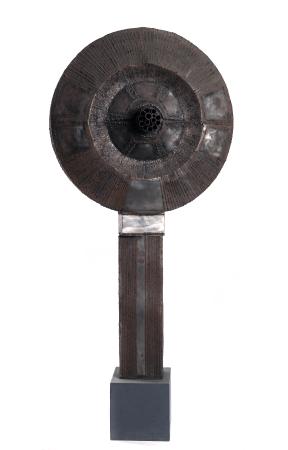
Winner, 1974
metal
MoCA Skopje
Naso Bekarovski’s sculpture “Winner” has a distinct front side. A circular disc with a plate-like rim rises from a pedestal; its center is defined by a depression from which a circular bulge protrudes. The enigmatic form is reminiscent of a shield, a target, or a sculptural emblem. Although the title refers to a winner, the work appears less as a trophy than as an archaic totem or a mysterious artifact from a murky past. It could be a monument, a landmark, or a darkened memorial, as well as a warlike artifact, a shield for defense, or a target to be struck.
The work belongs to that second phase in Bekarovski’s oeuvre that has been taking shape since the late 1960s. While his earlier works are figurative in nature and depict heads, human figures, or groups, Bekarovski later developed an increasingly abstract formal language. The organic, often expressively deformed figures of his youth give way to reduced volumes and clear, condensed forms. The drama remains, but is no longer depicted directly; rather, it is translated into a reduced form.
His biography provides a possible backdrop for this. Bekarovski was born in 1938 in the village of Želevo and was taken from his homeland during the Greek Civil War as one of the so-called “refugee children.” Experiences of loss, separation, and uprooting shape his generation. In his mature sculptures, these experiences do not appear as personal memories but are reinterpreted as general signs of the numinous and absence. The archaic-seeming forms therefore often appear like remnants of a lost culture or like memorials to something that can no longer be fully reconstructed.
“Winner” can also be read in this sense. The title promises triumph, yet the sculpture depicts no victory. Instead, we encounter a silent, closed form whose monumentality points less to domination than to memory and death. The work thus stands in stark contrast to the tradition of social realism, which in Yugoslavia was long characterized by political messages and heroic figures. Bekarovski replaces the language of pathos with the language of the material. Its true message lies not in telling a story, but in the persistent presence of a form that speaks of pain, memory, and endurance.