Sasha Auerbakh
born in 1985 in Moscow, USSR (today Russia); lives in Vienna, Austria
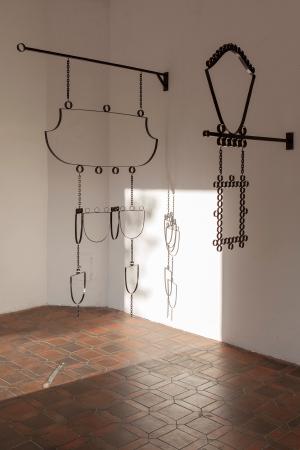
Untitled, 2020
wall objects in two parts, painted, made of steel
212 × 55 × 2.5 cm and 134 × 103 × 2.5 cm
Acquisition evn collection 2024
Inv. No. 0478
Following Kebab and Lollipop, both works from 2017, the two wall-mounted pieces Untitled caught the eye in 2024. They were on view in Sasha Auerbach’s first solo exhibition, Space Almond Head Void, at GOMO, an independent art space on Volkertplatz in Vienna’s Leopoldstadt district. In places like these—neither commercial galleries nor art dealers nor institutional spaces—spontaneity, a love of improvisation, and the tremendous dedication of everyone involved reign supreme. Art lovers adore them. There, one can find magnificent works by artists who, after graduating from college, find themselves in limbo, suspended in a state of uncertainty and waiting. This sense of emptiness and absence was already hinted at by the show’s title: the space, the head, the void… The two objects made of lacquered steel initially resemble the frames of tavern signs, as crafted by rural metalworkers. Auerbakh, however, frames not content, but pure air. Instead, her narrative is positively overflowing with philosophy, psychoanalysis, quantum physics, and Buddhism. The artist is most deeply influenced by the “internal objects” of the Austrian-British analyst Melanie Klein (1882–1960). As early as in early childhood, wrote Anna Freud’s rival, relationships form with people who provide security and love, but who can also evoke rejection. These remain unconscious throughout our lives and influence our perceptions and expectations of other people. It is fascinating how, at first glance, sculpture—the material result of her work—and conceptual thought seem almost irreconcilable in Sasha Auerbakh’s practice. We see decorative, festive objects, such as those found in Salzburg’s Getreidegasse, yet they lack precisely that “inner object” that influences our psychological well-being. It is precisely this absence that Auerbakh regards as a metaphor “for a bottomless, depressive state of mind.” The relationship between representation and mental image is thoroughly shaken in her work.continue reading
Text: Brigitte Huck, 2024
Translated with DeepL.com (free version)