Tanas Lulovski
born in 1940 in Zelevo, Greece; died in 2006 in Skopje, N. Macedonia
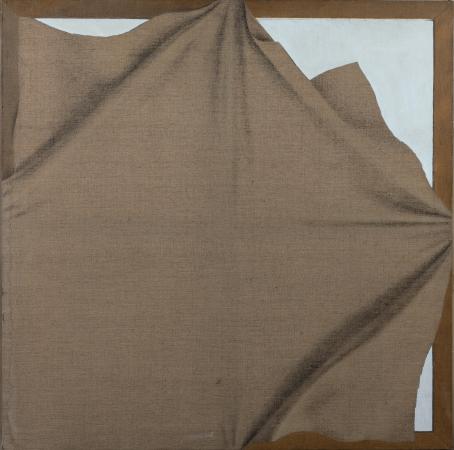
Untitled, 1984
acrylic on canvas
MoCA Skopje
The work Untitled by Tanas Lulovski (1984) plays with the boundaries between illusion and materiality. The image depicts a seemingly raw, unprimed canvas that has come loose from its mounting on the wooden frame and is sliding down in heavy folds, revealing a white background. Yet this material decay is pure illusion; it thus alludes to art history—more specifically, to the ancient Pliny myth of the contest between Zeuxis and Parrhasios. While Zeuxis painted grapes that attracted birds, Parrhasios triumphed with a painted curtain that tempted Zeuxis to try to push it aside.
Long before Lulovski, primarily Flemish painters revisited this history of deception. The trompe-l’œil painter Cornelis Gijsbrechts, for example, achieved fame in the 17th century by illusionistically painting the backs of paintings or peeling canvases, thereby making the medium itself the subject. Lulovski translates this historical art of illusion into the aesthetics of modernism: he paints the illusion of the deconstruction of his own picture support, thereby anticipating the concepts of the American artist Steven Parrino. While Parrino began shortly thereafter to physically tear his monochromatic canvases from their stretcher bars, crumple them, and re-drape them as sculptural “Misshaped Canvases,” Lulovski carries out this destruction of the classical panel painting purely through painting. His work is thus a kind of conceptual link: it unites the old-master fascination with optical illusion with the postmodern, physical deconstruction of painting.