Rudolf Stingel
born in 1956 in Meran, Italy; lives in New York, USA
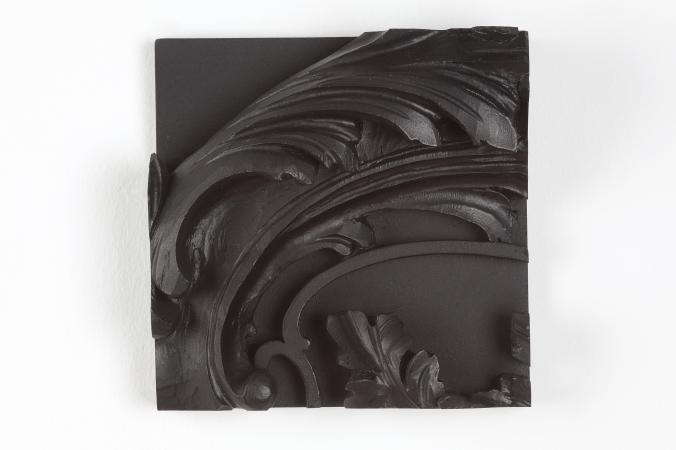
Untitled, 2012
glass reinforced polyester resin, polyurethane paint (annual gift Secession Vienna 2012)
12 × 12 × 3 cm
Acquisition evn collection 2012
Inv. No. 0293
Rudolf Stingel’s annual gift was created in connection with his solo exhibition at the Vienna Secession in 2012. Produced exclusively for supporters and patrons, this small-format work is neither available for general sale nor intended as a mere reproduction. Rather, it is an independent artistic work that stands in close dialogue with the artist’s oeuvre while simultaneously fostering a special bond between the artist, the institution, and the circle of supporters. Rudolf Stingel’s work is situated at the intersection of conceptual art, painting, and sculpture. Since the late 1980s, he has continuously questioned the traditional categories of painting. A central point of reference in his work is the history of ornamentation. Following its programmatic rejection by classical modernism, ornament was long regarded as a sign of the outdated and the decorative. Stingel consciously revisits this historically burdened form. His ornaments are neither narrative nor functional; they appear as abstracted structures within a multi-layered art-historical system of meaning. For the annual edition, Stingel employs a casting technique, with the cast generally serving as a central element of his artistic practice. This technique is embedded in an art-historical tradition ranging from ancient plaster copies to the strategies of Conceptual Art of the 1960s and 1970s. In Stingel’s work, however, the cast loses any utilitarian or reproductive function. It does not serve as a means of duplicating an original but rather brings about a deliberate shift in hierarchies: the negative mold and the copy become images in their own right. In this way, questions of authorship, originality, and the status of the image are explicitly addressed. The black square—a format highly charged with art-historical significance—stands for autonomy, absoluteness, and self-reference. In Stingel’s work, however, it is not employed as a metaphysical sign but as a component of a spatially conceived construct. The truncated ornament suggests both an imaginary ornamental extension and an architectural continuation beyond the picture’s boundaries. Within the context of the Vienna Secession, the annual gift can also be read as a reflection on its exhibition history. From the very beginning, the Secession was a site of productive tensions between decorative art, Symbolist ornamentation, and the claim to radical modernism. Stingel’s work also ties into this history.continue reading
Text: Heike Maier-Rieper, 2026
Translated with DeepL.com (free version)