Ahileas Apergis
born in Corfu, Greece in 1909, died in 1986 in Athens, Greece
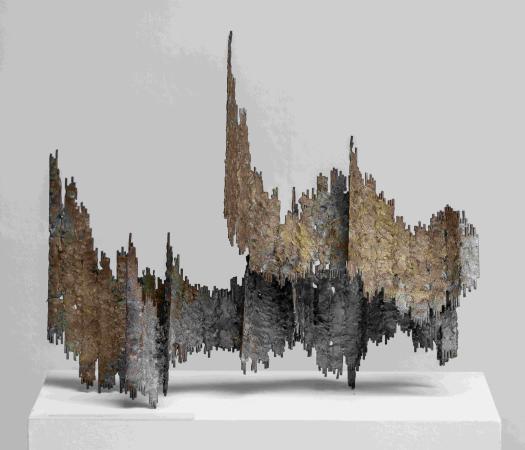
Phenomenon, 1974
MoCA Skopje
Ahileas Apergis’s work “Phenomenon,” created in 1974, is an iron sculpture measuring 48 × 58 × 28 cm. The title itself suggests the preferred interpretation. Here, the phenomenon is not understood as something that can be fixed, but as a state that reveals itself without ever being fully captured in a concept or image.
Apergis’ sculpture stands within the context of a European material aesthetic that underwent numerous renewals in the 1970s, in which industrial materials, constructive processes, and a reduced formal language enter into new relationships. His work moves between a seemingly constructive arrangement and an openness of the material that allows its own traces, reactions, and resistances to become visible. Here, iron is not merely a carrier of form, but an active component in the creation of the image—a material that does not resist time, but is at its mercy. The sculpture unfolds as a vertically structured construction of rods and thin-walled plate elements, whose surfaces range from gray and earthy tones to brass-like hues. Added to this is a rough material surface, in places marked as if by corrosion. These color and surface conditions subvert any heroic notion of patina and shift the focus to decay as a form-shaping moment, as work on the material itself. In doing so, Apergis consistently works on a model-like scale. The work remains small, not oriented toward monumentality or public installation. Precisely in this, it retains something provisional, open, and unfinished. Two tightly guided, curtain-like structures form the basic framework of a spatial drawing reminiscent of ephemeral phenomena such as the northern lights. These are not surfaces in the classical sense, but rather stratifications organized into gentle folds and undulating transitions—between compression and expansion, between proximity and distance—forming a graphic silhouette that resembles seismic recordings or mineral fractures. An asymmetrical movement shifts the balance of the construction. On the left are taller, more firmly anchored rods that taper toward the center and partially lift off the ground. Over and in front of them lies a second, tapering layer that reaches the highest point of the composition and at the same time steps in front of the order of the first structure like a disorienting curtain, like a strip phenomenon. Thus, “Phenomenon” appears less as a finished object than as a spatial constellation in which forces become visible without finally fixing themselves, as a drawing in space that seems to withdraw again the very moment it appears.continue reading
Text: Thomas D. Trummer, 2026
Translated with DeepL.com