Christian Kosmas Mayer
born in 1976 in Sigmaringen, Germany; lives in Vienna, Austria
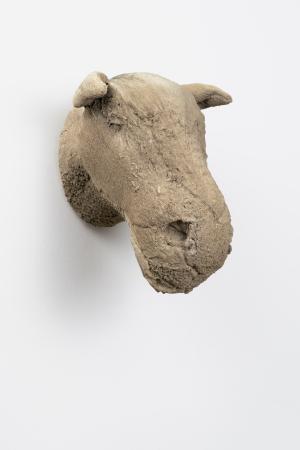
Petrified (horse head), 2015
plush, limestone
35 × 35 × 25 cm
Acquisition evn collection 2019
Inv. No. 0408
Near the northern English town of Knaresborough is a petrifying well: a spring that petrifies both organic and inorganic objects.
Every day, 3,200 liters of water containing lime and sodium sulfate in extremely high concentrations flow over a rock shaped like a giant head. In this tourist attraction, artist Christian Kosmas Mayer hung the head of a plush horse, which after a year under the falling water has assumed its current “fossilized” form. For the 2013 intervention Musis et Mulis (Muses and Mules) in Prince Eugene’s ceremonial stables at the Belvedere Palace, Mayer installed the fossilized horse’s head and a video about the circumstances of its creation together with a dense presentation of medieval sacred paintings and petrified tree trunks for the museum’s exhibition The Master of Lichtenstein Castle and His Time. A little later, he reconstructed the format of a European dripping or petrifying well with stuffed animals and cave elements at the Museum of Modern Art in Vienna. The stuffed animals had previously been placed in the Jardin des Fontaines Pétrifiantes in La Sône, France; as the water evaporated it gradually covered the stuffed animals with a layer of stone. At the mumok, the fossils were clearly identifiable visually, yet museum visitors puzzled over the tales of Lot’s wife, the miner of Falun, and the existential archaeology of Pompeii. Objects became forms of memory, time capsules, like the more historically interesting Voyager Golden Record or the disposable items in Andy Warhol’s cardboard boxes. Christian Kosmas Mayer has never been interested in trivialities like the depiction of reality. Nor is he interested in inventing anything. Like birdwatchers, who differ from ornithologists in a certain methodological freestyle, Mayer is more interested in (historical) phenomena and dispositifs than in universal laws. He often points his telescope into the past and zooms in on events, episodes and occurrences that have left traces in the fabric of society. The most beautiful results from the excavation work of the detail-oriented analyst lie in the dissection of an exact section. A virtuoso of multiple exposures, he assembles the results of his research into systems of found, experienced and forgotten images. Step by step, according to plan, he unearths alternative concepts of reality, rearranges them, and writes a new, unexpected script for reality. He interweaves different (everyday) cultural, political, and social contexts into appealing and visually intense tableaus that trace connections in content and make the modalities of perception visible. His artistic process is the montage of individual parts that together create a dense whole. This whole can be broken down again into its individual parts and rearranged; a system of hinges and loose connections allows the viewer to follow the individual narrative strands.continue reading
Text: Brigitte Huck, 2020
Translation: Virginia Dellenbaugh