Jeanne Spiteris
born in 1920 in Athens, Greece, died there in 2000
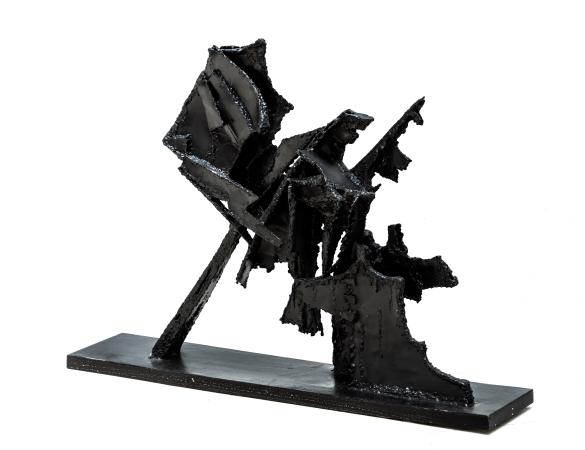
Pacing, 1962
iron
MoCA Skopje
Pacing (1962), the title of Jeanne Spiteris’s work, refers to a dynamic movement. Fans of long-distance sports, such as running or cycling, are familiar with the importance of this technique. It helps athletes pace themselves in terms of energy and speed and prevents a “slump” in stamina. This is clearly evident in Spiteris’s sculpture.
The sculpture consists of an open iron structure in which rough, flat metal struts form a rhythmic, wild composition. The individual elements appear like torn-off fragments striving in a single direction. The sculpture must stand on the floor to allow the viewer to perceive the “pulling away” of the movement even more clearly.
Jeanne Spiteris, also known as Ioanna Veropoulou-Spiteri, is one of the leading sculptors of postwar Greek modernism. After studying law, she turned to sculpture and studied in Athens. Extended stays in Venice and Paris shaped her artistic development and placed her within the context of the European avant-garde.
Since the 1960s, she has worked primarily with metal, creating sculptures in which tension, balance, and space play a central role. They exemplify the 1960s interest in structure, perception, and the relationship between body, space, and movement. At the same time, she is an important representative of feminist art—for it was precisely in the 1960s that female artists engaged with iron and metal sculpture, a field traditionally dominated by men. Pioneering artists such as Beverly Pepper and Louise Bourgeois are prime examples. Jeanne Spiteris’s abstract sculpture should also be viewed in this context.