Yannis Gaitis
born in 1923 in Athens, Greece, died in Athens in 1984
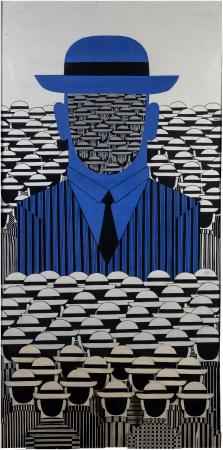
Mirror, 1977
oil, wood in color
MoCA Skopje
Yannis Gaitis is considered one of the most important Greek painters of the 20th century. His early years in the political underground and his clandestine anti-fascist work during the 1940s left a deep mark on his life’s work. The period of active resistance shaped his view of authoritarian power structures, blind social obedience, and the steady erosion of individual freedom.
The work Mirrors (1977) marks Gaitis’s striking shift toward representational painting. He abandoned his early abstract approach in favor of a universally comprehensible, almost poster-like code. The repetitive, completely faceless figures in their striped suits and identical hats - his “Anthropakia” (little people)—strongly evoke, in their cool, serial, and flat depiction, the pictorial statistics (Isotype) of the Austrian sociologist Otto Neurath (1882–1945). As with Neurath, the human being becomes here, too, a standardized sign and a mere pictogram. Yet while Neurath is concerned with enlightenment, Gaitis seeks political critique. Mirrors reflects a completely alienated mass society in which the individual is lost in uniformity. The literally blank face of the overpowering blue main figure is filled with countless other, tiny clones, an oppressive metaphor for the compulsion to conform.