Opy Zouni
born in 1941 in Cairo, Egypt, died in 2008 in Athens, Greece
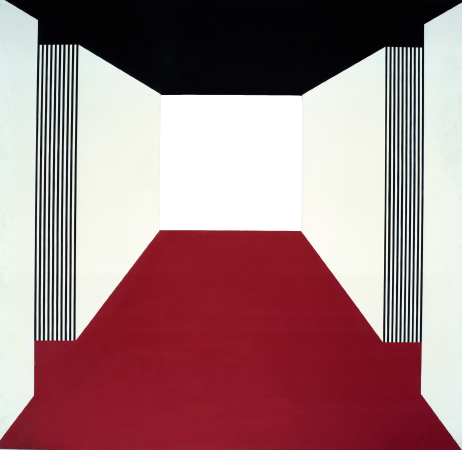
Expanding of One Surface – Interior, 1978
painted wood
MoCA Skopje
This work, painted on wood, explores questions of visual illusion and the perspectival construction of space through painterly means. It depicts an interior space in which the ceiling and floor appear as monochromatic surfaces without further internal detailing: the ceiling in black, the floor in dark red. On either side, the space—which, due to its emptiness, is reminiscent of an exhibition setting or a theater stage—is bounded by two white walls. Their narrow sides, which simultaneously appear as openings, are illusionistically rendered with a black-and-white pattern, creating the impression is created that the walls are composed of different types of wood or materials. In the center of the background is a square toward which the entire composition converges. This vanishing point of the pictorial space, however, turns out to be an empty space. The square has been cut out of the wood panel and reveals the wall behind it. At the museum in Skopje, this can be experienced firsthand, as the coarser surface structure and texture of the whitewashed museum wall clearly differ from the homogeneously painted wooden surface. The Cairo-born Greek painter Opy Zouni is classified as a geometric abstract artist. Her work revolves around the conditions of the pictorial space, architectural structures, optical effects, and spatial illusions. In Expanding of One Surface – Interior, she demonstrates how a two-dimensional surface (“one surface”) can be experienced as an architectural interior (“interior”) through lines, angles, and color composition. The tension between two-dimensional order and the effect of perspective depth is particularly evident here. The work on the one hand makes the autonomy of the pictorial elements as geometric forms visible, while on the other hand it evokes a representational perception that interprets these forms as walls, floor, and ceiling. Furthermore, Zouni incorporates the relationship between the image and real space into her considerations. The image no longer appears—as the long tradition of Western painting suggested—as a window to the world, but contains an actual window itself. The cut-out opening shatters the illusion of the depicted space while simultaneously drawing attention to the concrete architectural situation in which the work is situated. As a result, the pictorial representation loses its self-contained nature. Pictorial space and real space interlock directly with one another, so that the boundaries between representation and reality, between surface and space, become visible anew time and again.continue reading
Text: Thomas D. Trummer, 2026
Translated with DeepL.com