Stanko Pavleski
born in 1959 in Erekovci, Prilep, Yugoslavia (today N. Macedonia); lives in Skopje, N. Macedonia
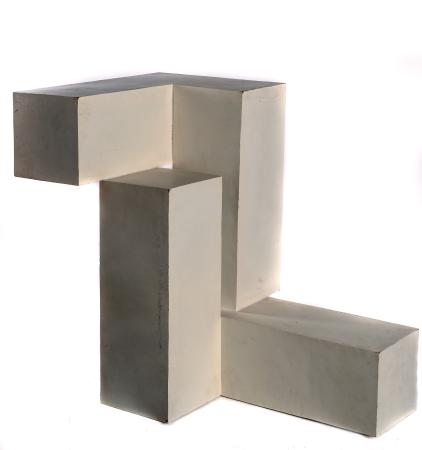
Changed Materiality – 4 cubes – 2 identical joints, 1987
painted metal
MoCA Skopje
The structure, consisting of four cuboids, is based on a principle of extreme formal reduction. All elements have an identical volume, the same proportions and the same surface texture. In fact, it consists of two interlocking pairs that interpenetrate and support one another. Part of the title (“2 identical joints”) refers to this structure of duplication, to two identical connections, joints or angles that organise the entire structure.
Two of the cuboids are positioned vertically and rest on their square end faces. The other two lie horizontally and are each offset by ninety degrees from one another, so that they point in different directions. The vertical elements each share an edge with the horizontal ones, creating an immediate, seamless connection. Despite their geometric rigour, this generates a dynamic that guides the viewer’s gaze along the edges, directions and intersections. The surface is finished in a greyish off-white. Although the material initially brings to mind marble, it is in fact metal that has subsequently been whitewashed. The difference between actual materiality and visual appearance is not insignificant. The work oscillates between heaviness and lightness, between industrial construction and the classical conception of sculpture and proportion. The white whitewash neutralises the material character of the metal and draws attention to the relationships between the volumes. Palevski’s work can be situated within the broader field of minimalist and post-minimalist sculpture. The reduction to elementary geometric forms is reminiscent of the approaches of Donald Judd or Robert Morris, whose works represent less objects in the traditional sense than investigations of spatial relationships. At the same time, Palevski’s object is not limited to a purely formal arrangement. Palevski also works as an author and theorist. In this sense, the sculpture can almost be read as a spatial conceptual model. Viewers instinctively begin to trace the constellation of its elements, imagine alternative arrangements and explore the possibilities of their composition. The work thus appears less as a definitive form than as a stimulus for cognitive processes, as a visible manifestation of one of many conceivable configurations. It is precisely here that its special quality lies. The sculpture does not merely present an object, but makes the conditions of its own construction tangible. It explores the relationship between part and whole, between repetition and difference, between being-as-such and possibility, and thus human thought itself.continue reading
Text: Thomas D. Trummer, 2026
Translated with DeepL.com