Tabita Rezaire
born in 1989 in Paris, lives in Cayenne, French Guyana
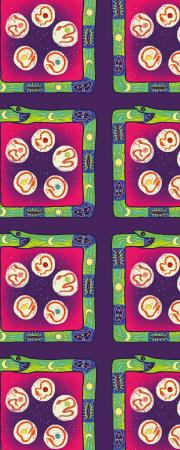
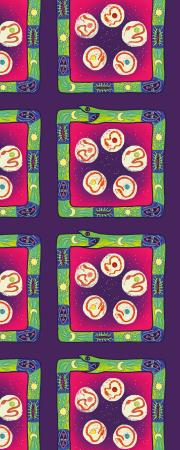
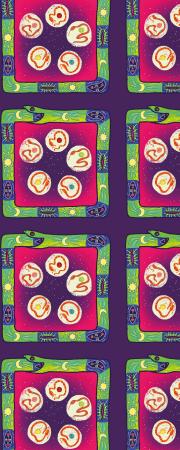
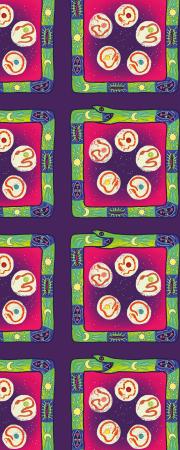
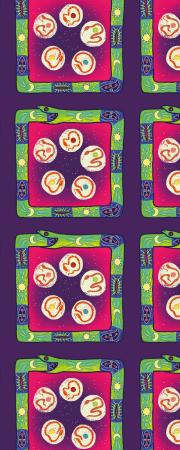
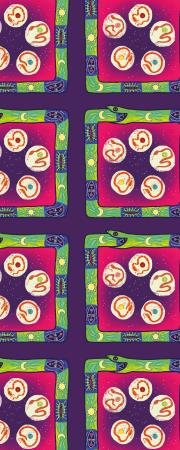
Serpent remembrance, 2021
wallpaper, recurring pattern, digitally edited
Commission evn collection 2021
First shown at Wallpaper #5, 2022 in Maria Enzersdorf, Austria
Inv. No. WP_23
In her multidisciplinary work, Tabita Rezaire combines spirituality, digital technologies, and decolonial forms of knowledge. Her works explore connections between the body, cosmos, and memory, opening up spaces where healing and belonging can be reimagined. This approach also shapes the wallpaper shown here. The work brings together motifs of planets, snakes, and the figure of Mother Moon into a pictorial space where cosmic order, female genealogies, and spiritual forces converge. The ornamental patterns in bold colors reflect Rezaire’s intensive engagement with the Saramaccans (Saamaka), an ethnic group in French Guiana. Since the 1980s, many members of this group have migrated from neighboring Suriname to the rainforests of Guiana due to political unrest. Today, they constitute a small yet culturally influential segment of the population. The Saramaccans are one of six Maroon communities that emerged from refugees of African descent and developed independent social and cultural structures beginning in the 17th and 18th centuries. A defining feature is their matrilineal organization: identity, property, and kinship are passed through the maternal line. Twelve large family groups, whose ancestry is traced back to African tribal mothers, form the basic social units. These clans shape community life more strongly than village structures. Religious practices and spiritual rituals play a central role. Rezaire approaches these systems of knowledge not in a documentary manner, but as living technologies of being. In the wallpaper, therefore, cosmological concepts, memory, and symbolic forces intertwine to form a pictorial space that mediates between Earth and the universe. The location of French Guiana, shaped by the Kourou Space Center with its rocket-accelerating equatorial conditions, reinforces this tension between planetary vastness and local history.continue reading
Text: Heike Maier-Rieper, 2026
Translated with DeepL.com (free version)